· Dissemination · 3 min read
SAIL 2026: MAPLES Multimodal OSCE Grading
SAIL 2026 poster walkthrough.
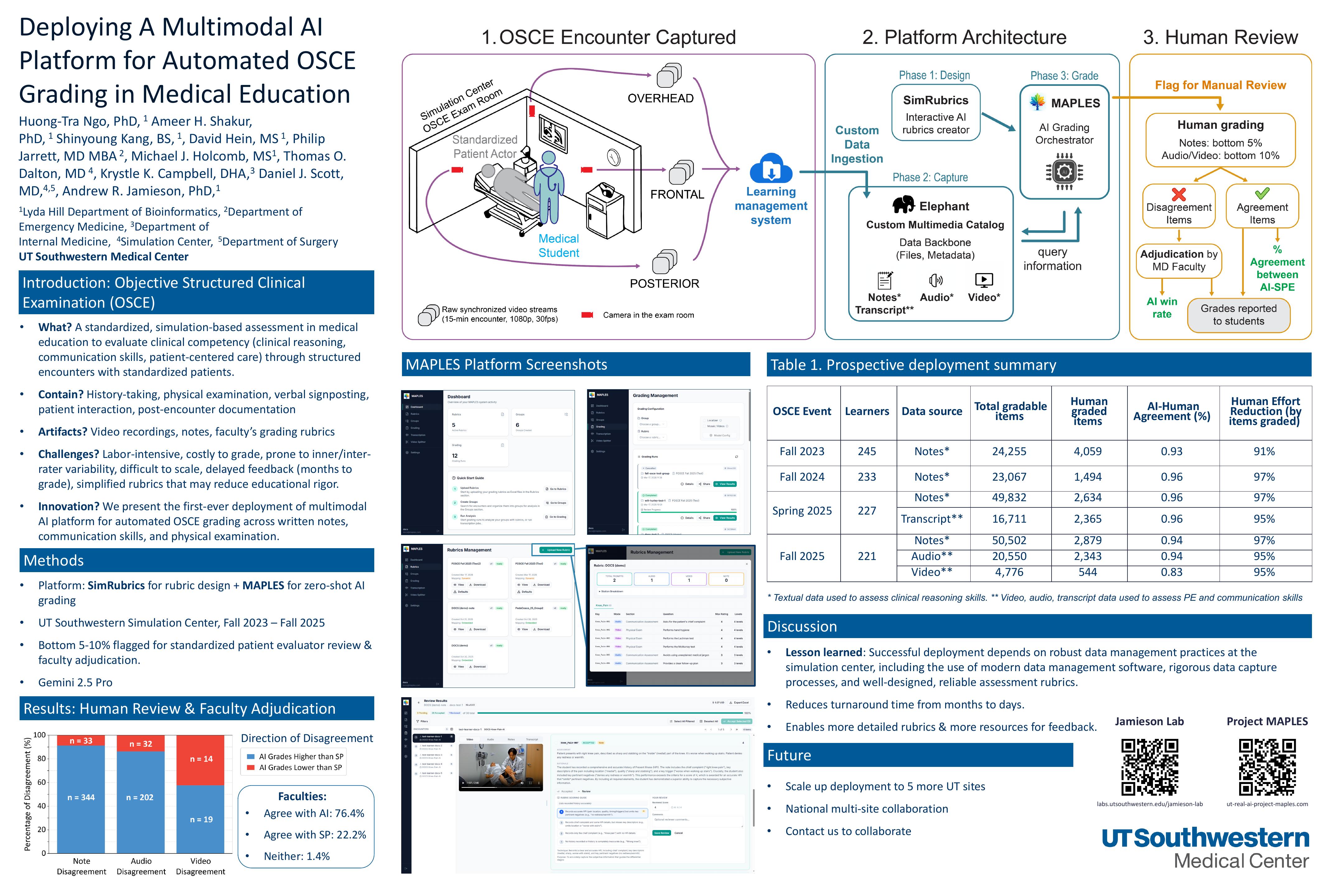
Tra Ngo, PhD, presented recent Jamieson Lab work at the 2026 Symposium on Artificial Intelligence for Learning Health Systems (SAIL) in Puerto Rico. The poster, “Deploying a Multimodal AI Platform for Automated OSCE Grading in Medical Education,” describes how MAPLES supports prospective AI-assisted assessment across written notes, communication skills, and physical examination performance.
SAIL brings together researchers, clinicians, educators, health system leaders, and AI practitioners focused on responsible AI development and deployment in healthcare. The 2026 meeting emphasized a shift from AI feasibility toward practical implementation, including prospective studies, trustworthy workflows, and real-world clinical deployment. Those themes closely match the UT-REAL goal: scaling AI-enabled simulation assessment across University of Texas medical schools.
Continuing The Lab’s SAIL Story
Tra Ngo’s 2026 poster builds on a sequence of Jamieson Lab work shared at SAIL.
In 2024, Andrew Jamieson presented “Rubrics to Prompts: Grading Medical Student Encounter Notes with Zero-shot Large Language Models,” which examined how large language models could grade OSCE clinical encounter notes without traditional model training.
In 2025, Ameer Hamza Shakur presented “Can we assess OSCEs through transcripts alone? A zero-shot AI approach to medical student evaluation,” extending the work from written notes toward transcript-based assessment of medical student performance.
At SAIL 2026, Tra Ngo presented the next step: prospective deployment of a multimodal AI platform that connects rubric design, simulation-center data capture, AI grading, and targeted human review.
The MAPLES Deployment
The platform brings together several components:
- Sim Rubrics supports structured rubric design.
- Elephant organizes OSCE artifacts such as notes, audio, transcripts, video, and metadata.
- MAPLES orchestrates grading by combining rubric information and student performance artifacts.
- Human review prioritizes lower-performing students and escalates large AI-human disagreements for faculty adjudication.
The poster highlights UTSW deployment work from Fall 2023 through Fall 2025. Across this period, the platform expanded from written-note grading to multimodal assessment using notes, audio, and video. The deployment reported consistently high AI-human agreement, substantial reduction in human grading effort, and faster turnaround of student feedback from months to days.
Why This Matters
OSCE grading is traditionally labor-intensive, costly, difficult to scale, and slow to return feedback to learners. The MAPLES deployment shows a practical pathway for addressing those constraints by pairing structured rubric design and multimodal data capture with AI-assisted grading and human-in-the-loop oversight.
This is not a replacement for faculty judgment. The stronger model is infrastructure: AI can reduce grading burden, accelerate feedback cycles, support more granular rubrics, and preserve human review where it matters most.
The work also has direct relevance for UT-REAL. Partner sites need more than a model; they need repeatable workflows for data inventory, artifact export, rubric representation, review, governance, and local implementation. Tra Ngo’s SAIL 2026 poster makes that deployment model concrete.