
Try the demo
Explore MAPLES with sample materials and see how assessment and feedback fit together.
Try the Demo
Access is by invitation. Choose “Request access” on the sign-in page.
Funded by the UT REAL Health AI Pilot Program · University of Texas System
The MAPLES AI grading platform is being prepared for governed multi-site validation across UT System medical schools, funded by the UT REAL Health AI Pilot Program.


Explore MAPLES with sample materials. Demo access is by invitation; choose “Request access” on the sign-in page to get started.
Partnering across the UT System to validate AI-enabled clinical assessment.





Our purpose
Our mission is to raise the quality and expand the possibilities of medical education by empowering educators, researchers, and students with accessible, responsible AI tools for teaching, learning, assessment, and discovery.
Take the next step
Start with the demo, explore local OASIS setup, or talk with our team.
Explore MAPLES with sample materials and see how assessment and feedback fit together.
Access is by invitation. Choose “Request access” on the sign-in page.
Explore the OASIS project and plan a setup for your own teaching or research environment.
Bring your goals and questions. Let's explore what MAPLES and OASIS could look like at your institution.
Technical setup, local workflows, and research collaboration.
Milestones, publications, and announcements from the project.

In the news: Julian Gill’s October 2 report features Andrew Jamieson and MAPLES in coverage of the UT-REAL initiative.

A prospective UTSW study brings multimodal AI into an objective structured clinical examination (OSCE), with targeted human review.
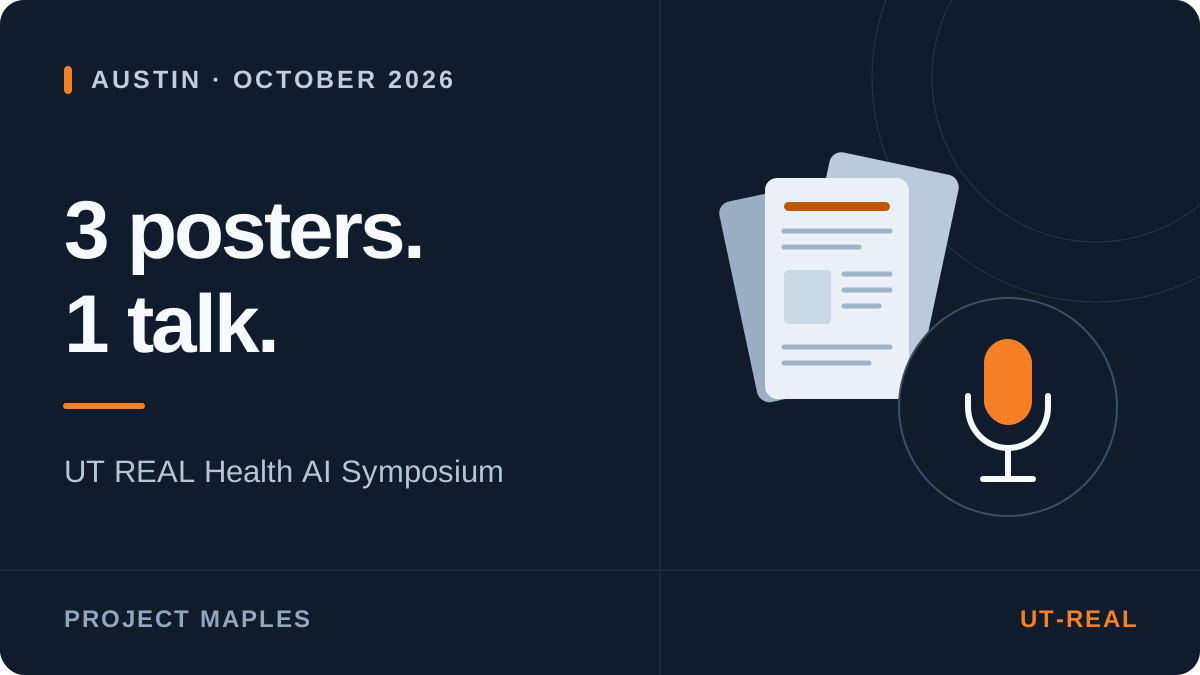
Project MAPLES and the Jamieson Lab shared work on AI assessment, continuous governance, rubric design, and privacy-preserving infrastructure at the October 7–8 symposium in Austin.
Collaborating across the UT System to validate AI-enabled clinical assessment.
View all participating sites →Project Aims
Working across UT medical schools to develop, evaluate, and share AI-assisted assessment practices.
Share strategies and best practices for designing AI-compatible OSCE rubrics, while allowing each school to customize assessment to their own educational philosophy and clinical needs.
Prepare MAPLES for governed multi-site deployment while evaluating UTSW-managed, site-specific, and UT Health Intelligence Platform (UT-HIP) infrastructure options. No cross-site production host has been selected.
Conduct rigorous validation studies comparing AI grading accuracy against expert human raters across diverse patient scenarios and institutions.
Define institution-specific hosting and transfer patterns, including a UT-HIP feasibility review, subject to site-specific IRB, data-use agreement, security, and hosting decisions.
Six UT medical schools sharing rubrics, best practices, and lessons learned — building a community of practice around AI-assisted clinical education.
Build on related NEJM AI and JMIR AI work, publish multi-site findings in peer-reviewed venues, and present project results at national conferences. See Research & Publications.
UTSW production and the six-school consortium.
From UTSW production to governed multi-school validation.
Phase 1: UTSW Proof-of-Concept (Complete)
AI grading system developed and deployed in production at UT Southwestern, with 7,000+ encounters graded. The grant proposal estimates that the six participating medical schools collectively represent more than 3,200 medical students. A 300-encounter retrospective medRxiv preprint reported three-camera AI grading agreement of quadratic weighted kappa = 0.830 against a physician-adjudicated reference, compared with 0.732 for standard human evaluators against the same reference.
Phase 2: Site Onboarding & Approval Routing (Current)
Funded by the UT REAL Health AI Pilot Program, March 2026 ($300K, 18 months). Award setup is complete. Partner sites are moving through local IRB review, agreement routing, data preparation, and infrastructure planning at different stages. UTSW and UT-HIP technical feasibility work is also underway.
Phase 3: Initial Multi-Site Validation (Upcoming)
Begin validation with the earliest-ready, authorized site data packages while continuing site-specific technical setup and governance review.
Phase 4: Broader Validation & Dissemination
Cross-institutional validation studies, publication of multi-site results, open-source governance playbook, and framework for national adoption.
Born at the UT Southwestern Simulation Center, the MAPLES platform has graded over 7,000 clinical encounters in production. A 300-encounter retrospective multimodal preprint reported three-camera AI grading agreement of quadratic weighted kappa = 0.830 against a physician-adjudicated reference, compared with 0.732 for standard human evaluators against the same reference. Related work is published in NEJM AI and JMIR AI. Now, through the UT REAL Health AI Pilot Program, the UT-REAL project is preparing that capability for governed validation across additional UT medical schools.